Getting rear-ended while stopped settlement: fault, coverage and timing
Getting rear-ended while stopped settlement claims turn on fault, injuries and insurance limits. Texas and Arizona both require a safe following distance, but a Texas appeals court says a rear-end crash alone does not prove negligence. No official source gives an average, so the rear-end collision settlement examples below are made up.
Last checked November 9, 2026 · Official sources (29)
Who is at fault when I am rear-ended while stopped?
The driver behind starts with the harder job. Both Texas and Arizona write a following-distance duty into their traffic laws. Texas requires an operator to keep an assured clear distance so the vehicle can safely stop without colliding with the one ahead. Arizona bars following another vehicle more closely than is reasonable and prudent.
That does not mean a stopped driver always wins. The law of proof differs by state, and the next section shows how.
How do Arizona and Texas treat fault in a rear-end crash?
| Question | Arizona | Texas | Florida (for contrast) |
|---|---|---|---|
| Is there a following-distance law? | Yes. No closer than reasonable and prudent. | Yes. Assured clear distance. | Not checked. |
| Is the rear driver presumed at fault? | We could not verify an Arizona presumption, so treat it as unsettled. | Not automatically. A Houston appeals court says a rear-end crash alone does not establish negligence. The plaintiff must prove specific negligent acts and cause. | Yes, a rebuttable presumption of negligence on the rear driver. |
| What if evidence points elsewhere? | The jury weighs it. | The jury weighs it. | The presumption vanishes when evidence supports a different account. |
| What if I share some blame? | Damages are reduced by your share. Your claim is not barred. | Damages are reduced by your percentage, and you cannot recover if you are over 50 percent. | Not checked. |
| Phone laws that may help prove the rear driver's fault | Holding a phone while driving is barred. | Reading or sending messages while driving is barred unless stopped. | Not checked. |
The Houston case is from an intermediate court, not the Texas Supreme Court, so a court elsewhere in Texas may not be bound by it. Still, it shows the starting point: proof, not a shortcut.
What if the driver who hit me says I stopped suddenly?
Expect it. Texas regulators list "both drivers were at fault" among the answers a driver's insurer may give. The usual arguments are a sudden stop, a brake light that did not work, a car that rolled back or reversed, and a stop in a place where stopping was not allowed.
Your share of blame matters in dollars. In Arizona, a finding that you were 20 percent at fault cuts your damages by 20 percent. In Texas, the same reduction applies, and a finding of more than 50 percent bars recovery.
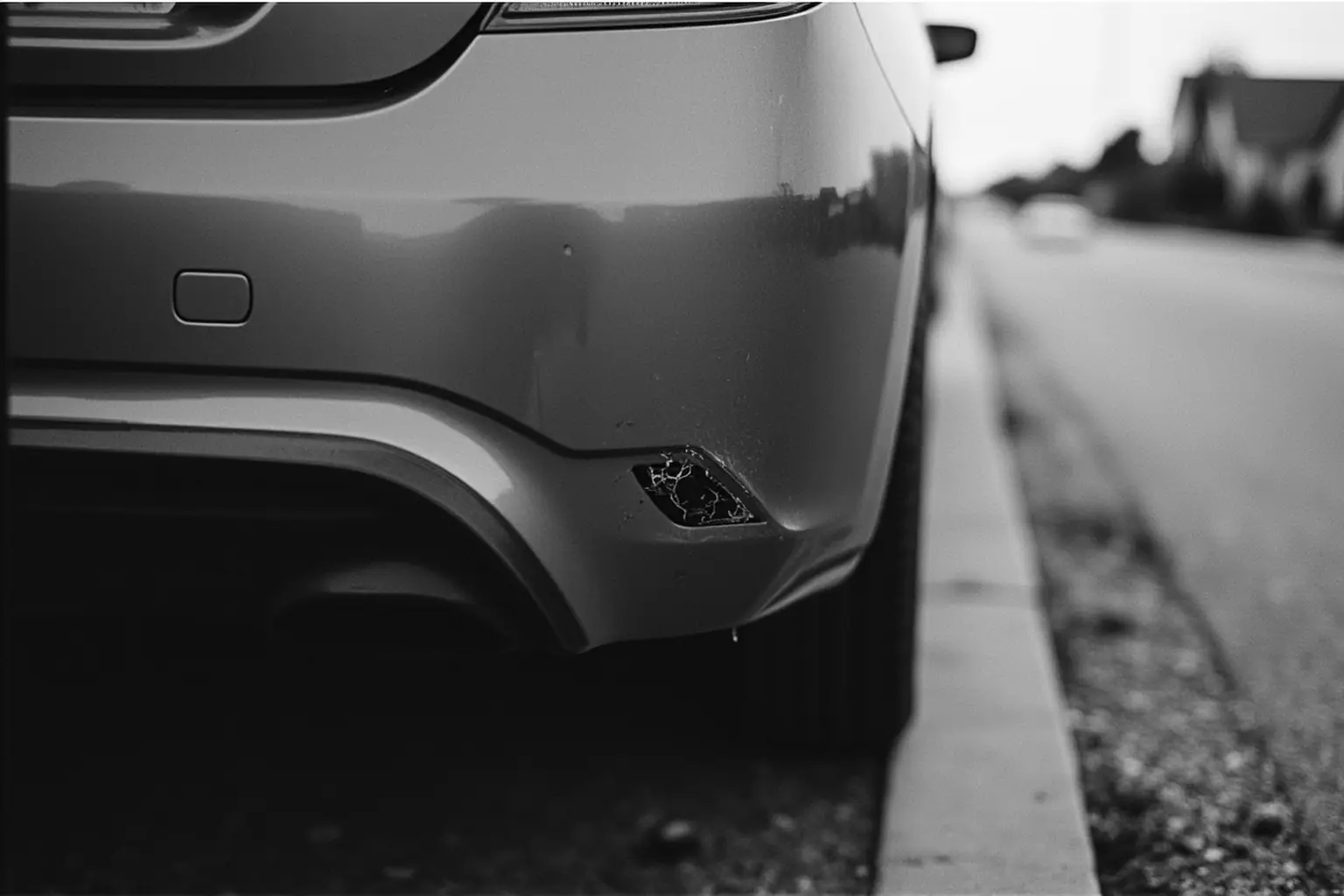
- Photograph both cars, their positions on the road, the skid or lack of skid, and the road ahead.
- Photograph your tail lamps and brake lights before any repair. Keep the damaged part.
- Get names and numbers of witnesses and any camera footage from nearby businesses, fast, because recordings can be erased.
- Ask that the police report note where you were and that you were stopped.
- Do not repair or scrap the car until a lawyer or your insurer says the evidence has been saved.
What injuries come from being rear-ended while stopped?
Neck injuries are the most familiar. The Insurance Institute for Highway Safety says neck sprains and strains are the most frequently reported injuries in U.S. auto insurance claims. Its whiplash test copies the hit a stationary vehicle takes from behind.
The pain may be late. MedlinePlus says whiplash pain may not appear right away and can take hours to weeks to develop. See a doctor early and keep going. A gap in care gives the insurer an argument that something else caused the pain.
What can a rear-end settlement cover?
Texas regulators say the other driver's insurance should pay for your car repairs, medical bills and a rental car. Lost pay and future care can be part of a claim. So can pain and suffering, which one consumer guide defines as the physical and mental distress someone might experience as the result of an injury.
Your own coverage may help first. Texas PIP pays regardless of who was at fault, but the law does not require insurers to offer more than $2,500 per person. Whatever the source, the amount available is limited by policy limits. Texas requires at least $30,000 of bodily injury liability coverage per person, and Arizona lists $25,000 per person. If the limit is too low, your own uninsured or underinsured motorist coverage may apply.
What are some rear-end collision settlement examples?
No government agency publishes an average for these claims, and the dollar figures on many websites come from sellers of legal services. The three cases below are EXAMPLES ONLY. Every number is made up to show what moves a result. None predicts your case.
| Example (made up) | What drives the number | What can change it |
|---|---|---|
| Stopped at a light. Neck strain. Six weeks of therapy. Back to work in a week. | Medical bills, a few lost days, and some pain and suffering. Smaller bills and a short recovery mean a smaller claim. | Missing appointments, a gap before treatment, or a dispute over who braked. |
| Stopped in traffic. Shoulder tear and surgery. Four months off work. | Larger bills, lost pay, future care and a long recovery. More at stake means a larger claim, and a bigger fight over it. | A low policy limit, a health plan lien, or a blame share assigned to the injured driver. |
| Stopped in a chain crash of three cars. Two people hurt. | Which car pushed which. One policy may be split. | Several insurers each pointing at another. |
Two worked examples of the math, also made up:
- Fault share. A jury finds damages of $20,000 and puts 20 percent of the blame on the stopped driver. In Arizona the award drops to $16,000. In Texas it also drops by the claimant's percentage.
- Policy limit. Damages are $80,000, but the at-fault driver carries Texas's minimum of $30,000 per person. The insurer's contract ends there. The rest would have to come from your own underinsured coverage, if you have it, or from the other driver directly.
What real court data can say: a federal study found plaintiffs won 64 percent of motor vehicle accident trials in 2005. But another study of large counties found only 3 percent of tort cases ended in a trial verdict and about three-quarters ended by agreed settlement or voluntary dismissal. Most cases are decided in negotiation.
How long do I have, and how long will it take?
The usual lawsuit deadline is two years in Arizona and two years in Texas. Negotiation can run for months, so build in time. If the insurer denies the claim, ask for the reason in detail and in writing. If you file a complaint with the Texas Department of Insurance about another driver's insurer, the company must write back to explain.
Remember that the adjuster works for the company paying the claim. Be polite, give facts, and do not guess about injuries.
What should I do after being rear-ended?
- Call 911 if anyone is hurt. Stay in the car or move to safety.
- Take photos before the cars move, if it is safe.
- Get the other driver's name, plate and insurance.
- See a doctor within a day or two, even if you feel fine.
- Report the crash to your own insurer and ask what coverage you have.
- Write down the deadline: two years from the crash for a lawsuit in Arizona or Texas, sooner for a government vehicle.
InjuryBasics is not a law firm. It cannot tell you what your claim is worth. A lawyer can read the police report and your policy limits and tell you where you stand.
Questions
Am I automatically not at fault if I was rear-ended while stopped?
Not automatically in every state. Florida presumes the rear driver was negligent, but the presumption can be rebutted. A Texas appeals court says a rear-end crash alone does not establish negligence.
How much is a rear-end collision settlement worth?
No official source gives an average. It depends on your medical bills, lost pay, fault share and the other driver's policy limit.
Can I still get paid if I was partly at fault?
Yes in Arizona, with a reduction for your share. In Texas, yes unless your share is greater than 50 percent.
What if the other driver has no insurance?
Your uninsured motorist coverage may apply.
How long do I have to sue?
Generally two years in Arizona and two years in Texas.
Find out if you are owed money.
A free case review. $0 upfront. No fee unless you win.
See if I’m owed moneySources (29)
- Tex. Transp. Code § 545.062, checked 2026-11-09. “maintain an assured clear distance between the two vehicles”
- A.R.S. § 28-730, checked 2026-11-09. “shall not follow another vehicle more closely than is reasonable and prudent”
- Benavente v. Granger (Tex. App.-Houston [1st Dist.] 2009), checked 2026-11-09. “Under common law, the mere occurrence of a rear-end collision does not establish negligence as a matter of law.”
- Birge v. Charron (Fla. 2012), checked 2026-11-09. “Under Florida decisional law, there is a rebuttable presumption of negligence that attaches to the rear driver in a rear-end motor vehicle collision case.”
- A.R.S. § 12-2505, checked 2026-11-09. “If the jury applies either defense, the claimant's action is not barred, but the full damages shall be reduced in proportion to the relative degree of the claimant's fault which is a proximate cause of the injury or death, if any.”
- Tex. Civ. Prac. & Rem. Code ch. 33, checked 2026-11-09. “a claimant may not recover damages if his percentage of responsibility is greater than 50 percent.”
- Insurance Institute for Highway Safety, checked 2026-11-09. “Neck sprains and strains are the most frequently reported injuries in U.S. auto insurance claims”
- MedlinePlus (NIH), checked 2026-11-09. “The pain of whiplash may not appear right away after an accident, but sometimes may take hours to weeks to develop.”
- Texas Department of Insurance, checked 2026-11-09. “The other driver's insurance should pay for your car repairs, medical bills, and a rental car.”
- Benavente v. Granger (Tex. App.-Houston [1st Dist.] 2009), checked 2026-11-09. “The plaintiff must prove specific acts of negligence on the part of the defendant driver and must prove proximate cause.”
- Birge v. Charron (Fla. 2012), checked 2026-11-09. “a rebuttable presumption, one that vanishes and loses its legal effect where evidence is produced from which a jury could conclude that the real fact is not as presumed”
- Tex. Civ. Prac. & Rem. Code § 33.012, checked 2026-11-09. “by a percentage equal to the claimant's percentage of responsibility”
- A.R.S. § 28-914, checked 2026-11-09. “Physically holds or supports with any part of the person's body either of the following”
- Tex. Transp. Code § 545.4251, checked 2026-11-09. “uses a portable wireless communication device to read, write, or send an electronic message while operating a motor vehicle unless the vehicle is stopped”
- Texas Department of Insurance, checked 2026-11-09. “Say both drivers were at fault and want you to pay some of your costs.”
- Insurance Institute for Highway Safety, checked 2026-11-09. “The sled delivers sudden pulses of acceleration to simulate the effect of a stationary vehicle being struck from behind.”
- Consumer Federation of America guide, posted by DC DISB, checked 2026-11-09. “Pain and suffering is the physical and mental distress someone might experience as the result of an injury.”
- Tex. Ins. Code § 1952.155, checked 2026-11-09. “the fault or nonfault of the named insured or recipient in causing or contributing to the collision”
- Tex. Ins. Code § 1952.153, checked 2026-11-09. “does not require an insurer to provide personal injury protection coverage in an amount that exceeds $2,500”
- Tex. Transp. Code § 601.072, checked 2026-11-09. “$30,000 for bodily injury to or death of one person in one collision”
- Arizona Department of Transportation, checked 2026-11-09. “$25,000 bodily injury liability for one person and $50,000 for two or more persons”
- Arizona DIFI, checked 2026-11-09. “Uninsured Motorist (UM) coverage protects you or passengers in your vehicle for bodily injuries sustained in an accident involving a driver who has no liability coverage.”
- Bureau of Justice Statistics, Civil Bench and Jury Trials in State Courts, 2005, checked 2026-11-09. “plaintiffs were most likely to win in cases involving an animal attack (75%), followed by motor vehicle accident (64%)”
- Bureau of Justice Statistics, Tort Cases in Large Counties, checked 2026-11-09. “About three-quarters of the cases were disposed through an agreed settlement or voluntary dismissal; 3% by a trial verdict.”
- A.R.S. § 12-542, checked 2026-11-09. “there shall be commenced and prosecuted within two years after the cause of action accrues”
- Tex. Civ. Prac. & Rem. Code § 16.003, checked 2026-11-09. “personal injury, forcible entry and detainer, and forcible detainer not later than two years after the day the cause of action accrues.”
- Texas Department of Insurance, checked 2026-11-09. “If the other insurance says they won’t pay you, ask for their reason in detail and in writing.”
- Texas Department of Insurance, checked 2026-11-09. “If you file a complaint about another driver’s insurance company, the company must write back to you explaining why they’re denying a claim or paying a certain way.”
- Texas Department of Insurance, checked 2026-11-09. “The adjuster works for the insurance company paying the claim.”