Worried about a loved one in a nursing home? What to do and who to call
If someone is in danger, call 911. Then call your state survey agency, which oversees nursing homes; anyone with concerns can file a complaint. Federal rules give every resident the right to be free from abuse and neglect. Ask for the chart in writing. The home must allow access within 24 hours, not counting weekends and holidays.
Last checked November 9, 2026 · Official sources (42)
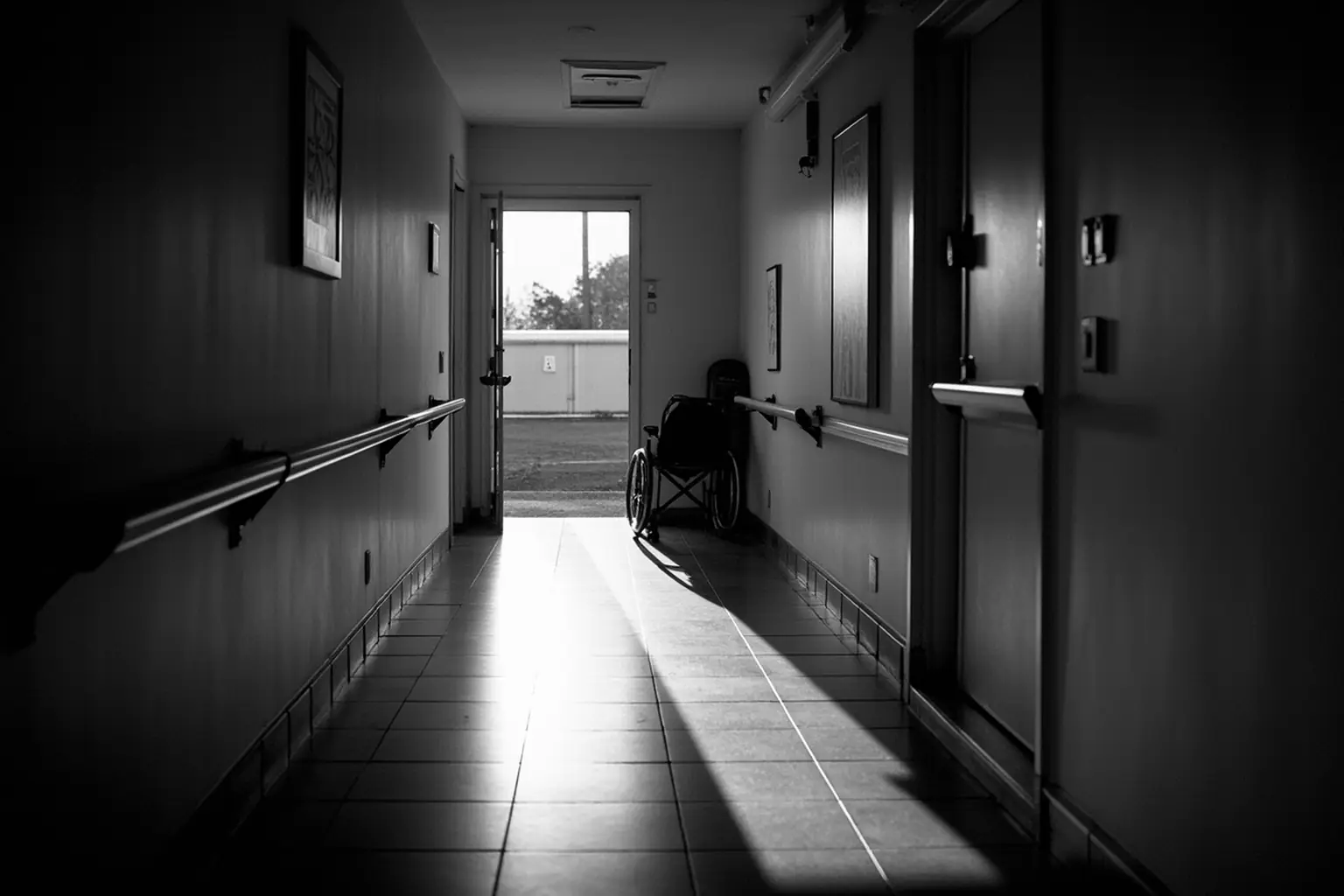
What are the signs of nursing home neglect or abuse?
You know your mother or your dad better than any chart does. If something feels wrong, it deserves a look. Not every fall or bruise means someone did wrong, and older bodies can decline even with good care. But these signs are worth asking about.
- Pressure sores, also called bedsores. A resident should not develop them unless their condition made them unavoidable.
- Repeated falls, or a fall nobody can explain. Each resident should have the supervision and devices needed to prevent accidents.
- Sudden weight loss, dehydration, or soiled clothes and bedding.
- Unexplained bruises, broken bones or new fear of a certain staff member.
- Medications missed, doubled or suddenly changed to make someone quiet.
- Call lights that go unanswered, or a staff that is always short.
- Missing money, jewelry, or sudden changes to bank accounts.

What should I do if I think my parent is being neglected at a nursing home?
- If there is danger or a crime, call 911. If a medical need is urgent, ask for transfer to a hospital.
- Take photos of any wounds or conditions, with dates, if your loved one agrees.
- Write down what you saw, who you spoke to, and the time.
- Speak to the director of nursing or administrator in writing. Ask what the care plan says and what will change.
- File a complaint with your state survey agency. You can do this even if you are not the legal guardian.
- Call the long-term care ombudsman, a free advocate for residents.
- Ask for the chart and any incident reports in writing. Do this before you move your loved one if you can.
- Talk to a lawyer who handles nursing home claims if there was serious harm or a death.
Who do I call to report a nursing home?
These offices do different jobs, and you can contact more than one. Residents have the right to complain without being punished for it.
| Who | What they do | Texas | Arizona |
|---|---|---|---|
| State survey agency | Investigates the facility, can cite and fine it | Texas HHS, 800-458-9858 | Arizona Department of Health Services, 602-364-2536 |
| Long-term care ombudsman | Free advocate who helps solve problems | 800-252-2412, free and confidential | Through Arizona DES and local programs |
| Adult Protective Services or police | Abuse, exploitation or crime | Texas law requires anyone with cause to believe to report. Call 911 for danger. | 1-877-SOS-ADULT |
An ombudsman acts only with the consent of the resident or their representative. A state complaint is different. It can lead to an inspection, but it will not pay your family for any harm, and it does not pause any legal deadline.
How can I see a nursing home's inspection reports?
Start with Medicare's Care Compare website. It gives each home an overall star rating, plus separate ratings for health inspections, staffing and quality measures. Stars are a summary, so read the details underneath.
A resident has the right to examine the most recent state or federal survey and any plan of correction. You can also ask the facility or the ombudsman for a copy of the full survey or the last complaint investigation. Look for the same problem coming up in report after report.
Note that these federal rules cover homes that take Medicare or Medicaid. Assisted living and memory care homes follow state rules instead, so ask your state agency what applies.
What records should a family save, and how fast do they disappear?
The chart must be kept for the period state law requires, or five years after discharge if state law is silent. Arizona requires six years for nursing care institutions. But the things that often matter most are not in the chart.
| Proof | Why it can vanish |
|---|---|
| Security video | Often recorded over quickly, so ask in writing right away |
| Staffing schedules | A lawyer usually needs to ask that they be preserved |
| Your photos and notes | Only exist if you take them |
| Call light logs and incident reports | May be kept in separate systems outside the chart |
| The facility's own report to the state | Allegations of abuse or serious injury must be reported within 2 hours |
A resident can see their records within 24 hours, excluding weekends and holidays, and get copies with 2 working days notice. If you hold a health care power of attorney or are the legal representative, bring proof. If your loved one has passed, the person handling the estate can usually make this request.
Did we sign away the right to sue? Arbitration agreements in nursing homes
Many families sign a stack of papers on admission day, often in a hard moment. One may be an arbitration agreement, which sends disputes to a private decision-maker instead of a jury.
Federal rules say a home that takes Medicare or Medicaid cannot require this as a condition of admission or continued care, and the resident can cancel within 30 calendar days of signing. Look through the admission packet now. If it is within 30 days, consider canceling in writing.
An older signed agreement may still be enforced. Texas law requires a strong boldface warning on these agreements, but the Texas Supreme Court ruled in a nursing home case that an insurance law exception did not protect that rule from the federal arbitration law.
In Arizona, a court held that the family's wrongful death claims were not covered by the resident's agreements. These issues depend on the exact paper and who signed it, so have a lawyer read it.
Who pays in a nursing home case, and what can it cover?
Usually the facility's liability insurer pays. Many homes are owned by companies with several layers of ownership, so a lawyer will ask who ran and funded the home.
A claim can cover medical care caused by the neglect, a move to a safer home, and pain and suffering. If your loved one has died, a wrongful death or survival claim may apply. Money is rarely the reason families come forward, but these costs are real.
Medicare must be repaid from any settlement for care it paid for because of the injury. Medicaid may also seek repayment. Ask for these amounts before you agree to any offer. If it is a state or county home, a much shorter notice deadline can apply: 180 days in Arizona and six months in Texas.
How do nursing home claims differ in Arizona and Texas?
| Rule | Arizona | Texas |
|---|---|---|
| Main law | Adult Protective Services Act, A.R.S. 46-455, against any person or enterprise employed to provide care | Chapter 74, because a nursing home is a health care institution |
| What is neglect or abuse | Abuse includes injury from negligent acts or omissions. The claim needs a vulnerable adult, an injury, abuse and a caregiver | Treated as a health care liability claim |
| Deadline | Two years after actual discovery | Generally two years from the act or end of treatment |
| Before or after filing | Serve the attorney general within 30 days after filing | Written notice 60 days before suit, and an expert report 120 days after each defendant answers |
| If the resident dies | The claim survives death | Death cases have a separate limit on all damages, starting at $500,000 and adjusted for inflation |
| Limits on damages | None | $250,000 per claimant in pain and suffering against a single institution |
What mistakes do families make, and how can you avoid them?
- Waiting for the facility to finish its own review before calling anyone.
- Moving your loved one and leaving without copies of the chart.
- Assuming you lost your rights because you signed admission papers.
- Thinking a state complaint protects your legal deadline. It does not.
- Blaming yourself. You trusted people who were supposed to care for your family.
If this has happened to your family, you did not cause it. You can take these steps one at a time, and you do not need to have every answer before you ask for help.
Questions
How do I report a nursing home in Texas?
Call Texas HHS at 800-458-9858 for a complaint about care. For an advocate, call the long-term care ombudsman at 800-252-2412.
How do I report a nursing home in Arizona?
Call the state survey agency at 602-364-2536, and report abuse to Adult Protective Services at 1-877-SOS-ADULT.
Can a nursing home retaliate against my mom for complaining?
Federal rules give residents the right to complain without discrimination or reprisal. Tell the ombudsman or the state agency if you see this happen.
How long do we have to file a claim?
Generally two years in Texas and two years after actual discovery in Arizona. Government-run homes can have much shorter notice deadlines.
Can we still sue if my father signed an arbitration agreement?
Sometimes, but a claim may go to an arbitrator instead of a jury. Federal rules bar requiring one for admission and allow cancelling within 30 days. A lawyer should read the actual agreement.
Nursing home abuse or neglect? See if you are owed money.
A free case review. $0 upfront. No fee unless you win.
See if I’m owed moneySources (42)
- Medicare.gov, checked 2026-11-09. “Anyone with knowledge or concerns about the care of a resident in a nursing home may file a complaint with their State Survey Agency.”
- 42 CFR 483.12, checked 2026-11-09. “The resident has the right to be free from abuse, neglect, misappropriation of resident property, and exploitation”
- 42 CFR 483.10, checked 2026-11-09. “within 24 hours (excluding weekends and holidays)”
- 42 CFR 483.12, checked 2026-11-09. “not later than 2 hours after the allegation is made”
- 42 CFR 483.70, checked 2026-11-09. “must not require any resident or his or her representative to sign an agreement for binding arbitration as a condition of admission to”
- 42 CFR 483.70, checked 2026-11-09. “the right to rescind the agreement within 30 calendar days of signing it”
- A.R.S. 46-455, checked 2026-11-09. “may file an action in superior court against any person or enterprise that has been employed to provide care”
- A.R.S. 46-455, checked 2026-11-09. “shall be commenced within two years after actual discovery of the cause of action”
- Texas Civ. Prac. & Rem. Code 74.001, checked 2026-11-09. “(J) a nursing home”
- Texas Civ. Prac. & Rem. Code 74.251, checked 2026-11-09. “within two years from the occurrence of the breach or tort”
- Texas Civ. Prac. & Rem. Code 74.351, checked 2026-11-09. “not later than the 120th day after the date each defendant's original answer is filed”
- 42 CFR 483.25, checked 2026-11-09. “does not develop pressure ulcers unless the individual's clinical condition demonstrates that they were unavoidable”
- 42 CFR 483.25, checked 2026-11-09. “Each resident receives adequate supervision and assistance devices to prevent accidents.”
- 42 CFR 483.10, checked 2026-11-09. “without discrimination or reprisal and without fear of discrimination or reprisal”
- Texas HHS, checked 2026-11-09. “Call 800-458-9858 to report complaints about the care or treatment of someone served by a Regulatory Services provider”
- CMS, checked 2026-11-09. “Phone Number 602-364-2536”
- Texas Long-Term Care Ombudsman, checked 2026-11-09. “Call 800-252-2412 to speak with an LTC ombudsman in your area”
- Texas Long-Term Care Ombudsman, checked 2026-11-09. “Services are free, confidential and available statewide.”
- Arizona DES, checked 2026-11-09. “main goal is to receive, investigate, and resolve complaints”
- Texas Health & Safety Code 260A.002, checked 2026-11-09. “shall report the abuse, neglect, or exploitation in accordance with this chapter”
- Arizona DES, checked 2026-11-09. “1-877-SOS-ADULT (1-877-767-2385)”
- Texas Long-Term Care Ombudsman, checked 2026-11-09. “ombudsmen only take action with the consent of the resident or their representative”
- CMS, checked 2026-11-09. “There is one Overall 5-star rating for each nursing home, and separate ratings for health inspections, staffing and quality measures.”
- 42 CFR 483.10, checked 2026-11-09. “Examine the results of the most recent survey of the facility conducted by Federal or State surveyors”
- Medicare.gov guide, checked 2026-11-09. “You can also ask for a copy of the full survey or the last complaint investigation report.”
- 42 CFR 483.70, checked 2026-11-09. “Five years from the date of discharge when there is no requirement in State law”
- A.R.S. 12-2297, checked 2026-11-09. “shall retain patient records for six years after the date of the patient's discharge”
- 42 CFR 483.10, checked 2026-11-09. “upon request and 2 working days advance notice to the facility”
- Texas Civ. Prac. & Rem. Code 74.451, checked 2026-11-09. “UNDER TEXAS LAW, THIS AGREEMENT IS INVALID AND OF NO LEGAL EFFECT UNLESS IT IS ALSO SIGNED BY AN ATTORNEY OF YOUR OWN CHOOSING”
- Texas Supreme Court, Fredericksburg Care v. Perez (2015), checked 2026-11-09. “We hold that the MFA does not apply to section 74.451”
- Arizona Court of Appeals, Duenas v. Life Care (2014), checked 2026-11-09. “wrongful-death claims are not subject to the resident”
- CMS, checked 2026-11-09. “it must be repaid to Medicare when a settlement, judgment, award, or other payment is made”
- A.R.S. 12-821.01, checked 2026-11-09. “within one hundred eighty days after the cause of action accrues”
- Texas Civ. Prac. & Rem. Code 101.101, checked 2026-11-09. “not later than six months after the day that the incident giving rise to the claim occurred”
- A.R.S. 46-451, checked 2026-11-09. “Injury caused by negligent acts or omissions.”
- Arizona Supreme Court, Delgado v. Manor Care (2017), checked 2026-11-09. “(1) a vulnerable adult, (2) has suffered an injury, (3) caused by abuse, (4) from a caregiver”
- A.R.S. 46-455, checked 2026-11-09. “within thirty days after the action is filed with the superior court”
- Texas Civ. Prac. & Rem. Code 74.051, checked 2026-11-09. “at least 60 days before the filing of a suit”
- A.R.S. 46-455, checked 2026-11-09. “shall not be limited or affected by the death of the vulnerable adult”
- Texas Civ. Prac. & Rem. Code 74.303, checked 2026-11-09. “the limit of civil liability for all damages, including exemplary damages, shall be limited to an amount not to exceed $500,000 for each claimant”
- Arizona Constitution, art. 2, sec. 31, checked 2026-11-09. “No law shall be enacted in this state limiting the amount of damages to be recovered for causing the death or injury of any person”
- Texas Civ. Prac. & Rem. Code 74.301, checked 2026-11-09. “where final judgment is rendered against a single health care institution”